-Oct-09-2026-12-43-59-8229-PM.png)
For all the excitement around AI, one question is becoming harder to ignore: does knowing more about a consumer actually mean understanding them better?
AI can recognise patterns across billions of signals, connect seemingly unrelated behaviours and make increasingly sophisticated predictions. But patterns do not exist in isolation. Its significance depends on context.
A consumer researching a credit card is not showing the same intent as a consumer browsing a new game. Someone comparing flights is on a different decision journey than someone choosing a healthcare service. Even when two consumers behave identically online, what that behaviour means can change entirely depending on the category they’re in.
This is where the next chapter of AI-led consumer intelligence is likely to be defined. Not by how broadly a system can understand consumers, but by how deeply it can understand the context in which they make decisions. That means moving beyond a one-size-fits-all view of the consumer toward intelligence that understands the nuances of individual industries, their consumer journeys, their personas, their signals of intent and what a meaningful outcome actually looks like within that category.
Why do consumers behave differently across categories?
There is no single definition of consumer intent. For years, consumer intelligence has often been built around identifying common patterns: who a consumer is, what they have done, what they might be interested in and what they are likely to do next.
The decision to download a gaming app is a different kind of decision than choosing a financial product. A travel booking often involves extended consideration; a commerce purchase may be shaped by immediacy, value and context.
The person may be the same. The meaning of their behaviour is not.
This is precisely why verticalisation matters.
As Affle CEO Anuj Khanna Sohum mentioned during Q3 FY2026 earnings call, “The first one is verticalization where we go and deeply work as a tech platform. For example, if we are working with a healthcare customer, we are able to give them not just a consumer conversion, but a conversion of what they see as their patients or revenue generating users. The persona of those people that they are targeting is like a patient. In the entertainment category, we are giving them users who are viewers, who are subscribers, who will pay to subscribe or gamers or shoppers. For education tech, in one of the case studies, we are talking about targeting parents of students who would then convert for education tech. So first is the deeper verticalization strategy and the second factor is giving them premium placements and driving premium user conversions who will have a higher lifetime value for the advertiser.”
The implication is significant: Consumer intelligence becomes more valuable when it understands not just the person, but the persona that person represents within a particular category.
Verticalization is not segmentation
It is tempting to think of verticalization as simply sorting consumers into industry buckets. But that would undersell the idea.
Segmentation tells us that consumers are different. Verticalized intelligence understands why those differences matter. It connects the category to the consumer, the persona to the journey, and the signal to the outcome.
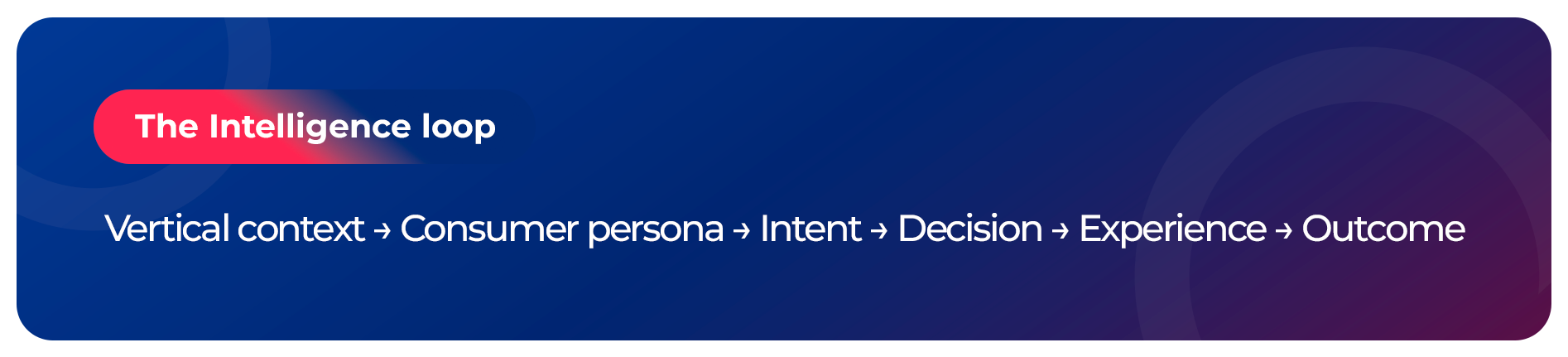
This creates a richer intelligence loop, from vertical context to consumer persona, to intent, to decision, to experience, and finally to outcome, with each layer informing the next. The vertical provides the context. The consumer intelligence layer identifies the relevant behaviors, personas, and signals. AI interprets those signals and continuously learns from them.
This is what makes verticalization an intelligence architecture, not simply an industry strategy.
From vertical expertise to verticalised intelligence
Verticalisation is not new to Affle. It has anchored our Consumer Platform strategy for years, reflected in our focused approach across the EFGH verticals: E-commerce, Fintech, Gaming and Healthcare, among others.
The thinking has always been straightforward: consumer behaviour cannot be understood independently of the category it takes place in. Over time, that meant building deeper knowledge of different consumer journeys, category dynamics and the outcomes that matter within each vertical, a foundation that becomes increasingly important as AI expands what's possible with that intelligence.
The opportunity now is to move from vertical expertise, the knowledge built around specific categories and consumers, to verticalized intelligence that can continuously interpret, learn, and act on that knowledge.
For marketers, this changes the question worth asking: not how much it knows about the consumer, but whether it understands what that consumer is trying to do in this category right now.